ADEVIS decomposes large camera motions into small increments and uses intermediate views as geometric and visual priors for extreme-view synthesis.
DEVIS-GRPO: Unleashing GRPO on Dynamic Extreme View Synthesis
A GRPO-based framework for trajectory-controlled video generation that learns to handle extreme camera motions without collecting expensive paired large-view videos.
1Xidian University 2State Key Laboratory of General Artificial Intelligence, BIGAI
*Equal contribution
†Corresponding author
Abstract
Trajectory-controlled video generation enables controllable video synthesis, but existing methods often degrade under large-angle camera motions and typically require expensive paired videos for extreme-view training. We propose Dynamic Extreme View Synthesis-GRPO (DEVIS-GRPO), a GRPO-based framework for camera-controlled dynamic extreme-view video generation. Its core strategy, Accumulative Dynamic Extreme View Synthesis (ADEVIS), synthesizes large viewpoint changes by progressively accumulating small-angle motions. A multi-level consistency-quality reward then selects high-quality samples for policy optimization. DEVIS-GRPO improves training efficiency, increases trajectory diversity, and enables direct extreme-view generation at inference time. Experiments on Kubric-4D, iPhone, and DL3DV show improved scene consistency, motion smoothness, and visual quality.
Method Overview
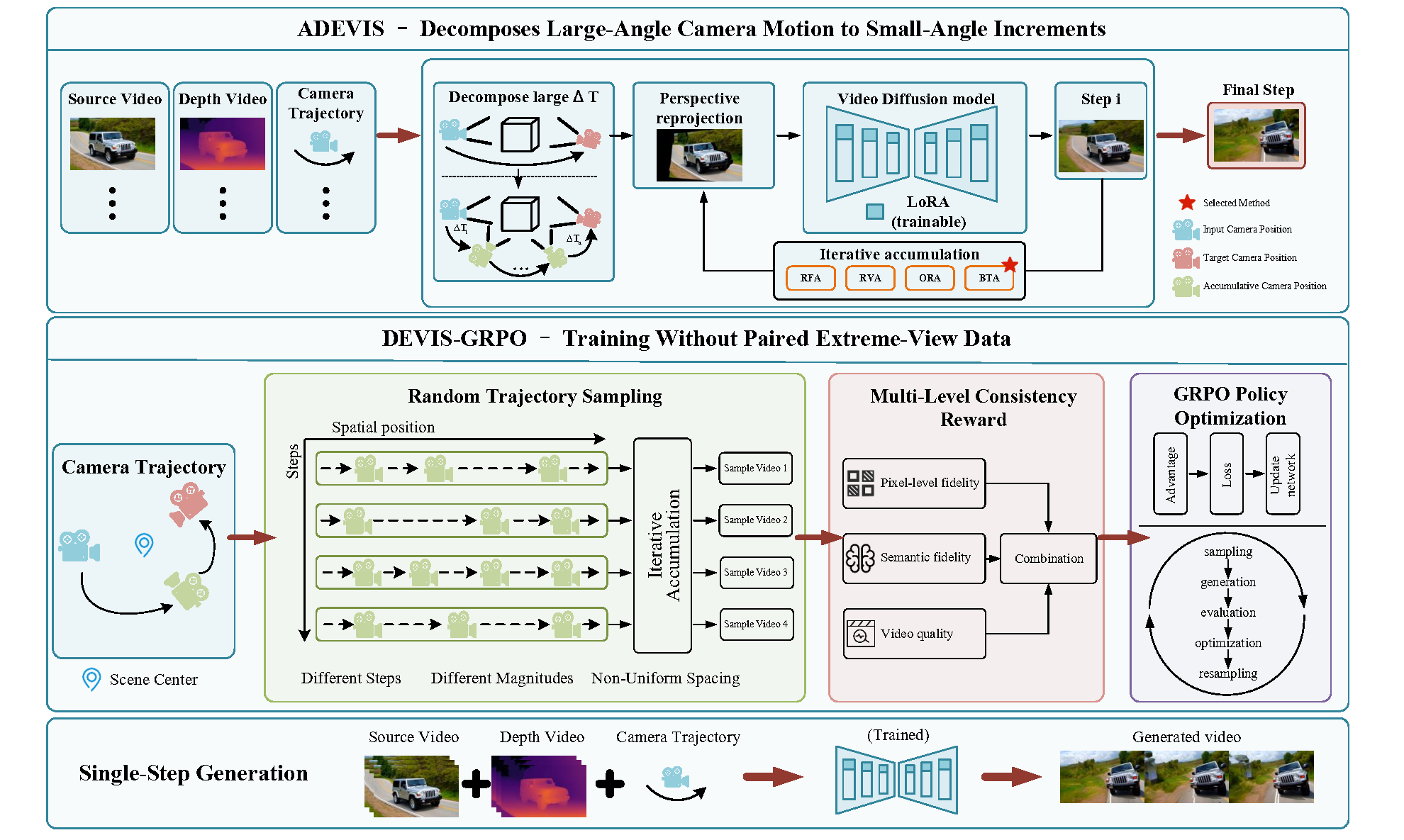
Overview of the proposed DEVIS-GRPO framework. ADEVIS decomposes large-angle camera motions into small-angle increments for accumulative extreme-view synthesis, while DEVIS-GRPO randomizes this process to generate diverse trajectory groups and optimizes the policy model using consistency-quality rewards.
The reward measures pixel-level consistency, semantic consistency, and video quality to guide policy optimization.
DEVIS-GRPO obtains diverse sample groups by randomizing configurations, removes the need for paired large-angle videos to warm-start the policy, and enables direct extreme-view generation after optimization.
BibTeX
@article{zuo2026devis,
  title={DEVIS-GRPO: Unleashing GRPO on Dynamic Extreme View Synthesis},
  author={Zuo, Yi and Wu, Huimin and Li, Lingling and Liu, Fang and Jiao, Licheng and Li, Qing},
  journal={arXiv preprint arXiv:2605.16937},
  year={2026}
}